OPROV Field 01 is an emerging robotics project exploring how mobile robotic assistants could support real-world technical work. Its development direction includes modular tool storage, network inspection, documentation, cable assistance, and future integration with Optimal Field Desk.
OPROV Field 01 · Interactive concept visualization
FIELD 01 / MOBILE FIELD ASSISTANTOriginal concept geometry · Field tools configuration
Zoom & rotation
Two concepts. One proposed interface.
Scroll normally. Enable rotation to inspect the model; finish rotating to restore touch scrolling.
Scripted sequence complete
The poster and all explanations are available while 3D prepares.
DESIGNED AROUND THE WORK
Tools, inspection and a place for the gear.
Inspect the original Field 01 design. The equipment tray, two task-focused arms and modular storage interface express practical work roles—not validated specifications.
Choose your view.
Look at the work side, the removable storage dock or the inspection details. All mechanisms shown are design studies that require physical engineering and testing.
OPROV is an early-stage robotics initiative. These original models and scripted demonstrations show a future product direction, not a deployed or commercially available robot. Module compatibility, payload and physical safety are unverified.
Grounded in the work we do
A field assistant. With a reason to be there.
Technical work involves more than the connection itself: getting tools to the right place, finding the correct drawing, keeping equipment labels straight and documenting what changed.
We developed Field Desk to organize that context. OPROV Field 01 is the next research question: could a supervised mobile assistant help with the physical work and contribute better evidence to the same record?
Each scenario pairs a physical assistance idea with the record a technician would need afterward.
01
Inspect the rack
Position beside the rack, orient the inspection head and bring a labeled patch-panel location into the observation. The technician decides what the image can establish.
Example rack image reference, panel label and a note linked to the equipment record.
Visual context only. No continuity test, configuration change or network-health result.
02
Assist with Ethernet cabling
Present a lightweight Cat6 patch lead beside the wall data drop. The removable organizer keeps RJ45 connectors and accessories close while the second arm supports inspection lighting. The technician retains all installation responsibility.
A cable identifier, wall-drop reference and technician-reviewed installation note.
Scripted presentation; no validated grip force, autonomous termination or cable pulling.
03
Carry the gear
Your tools, right where the work happens. A secured organizer travels on the chassis to the technician’s work area. The robot parks, presents its parts tray and returns its arm to a ready pose.
An illustrative work step: module checked, supplies presented and job context retained.
No validated payload, braking performance or productivity savings. Module fit and retention require physical tests.
04
Document everything
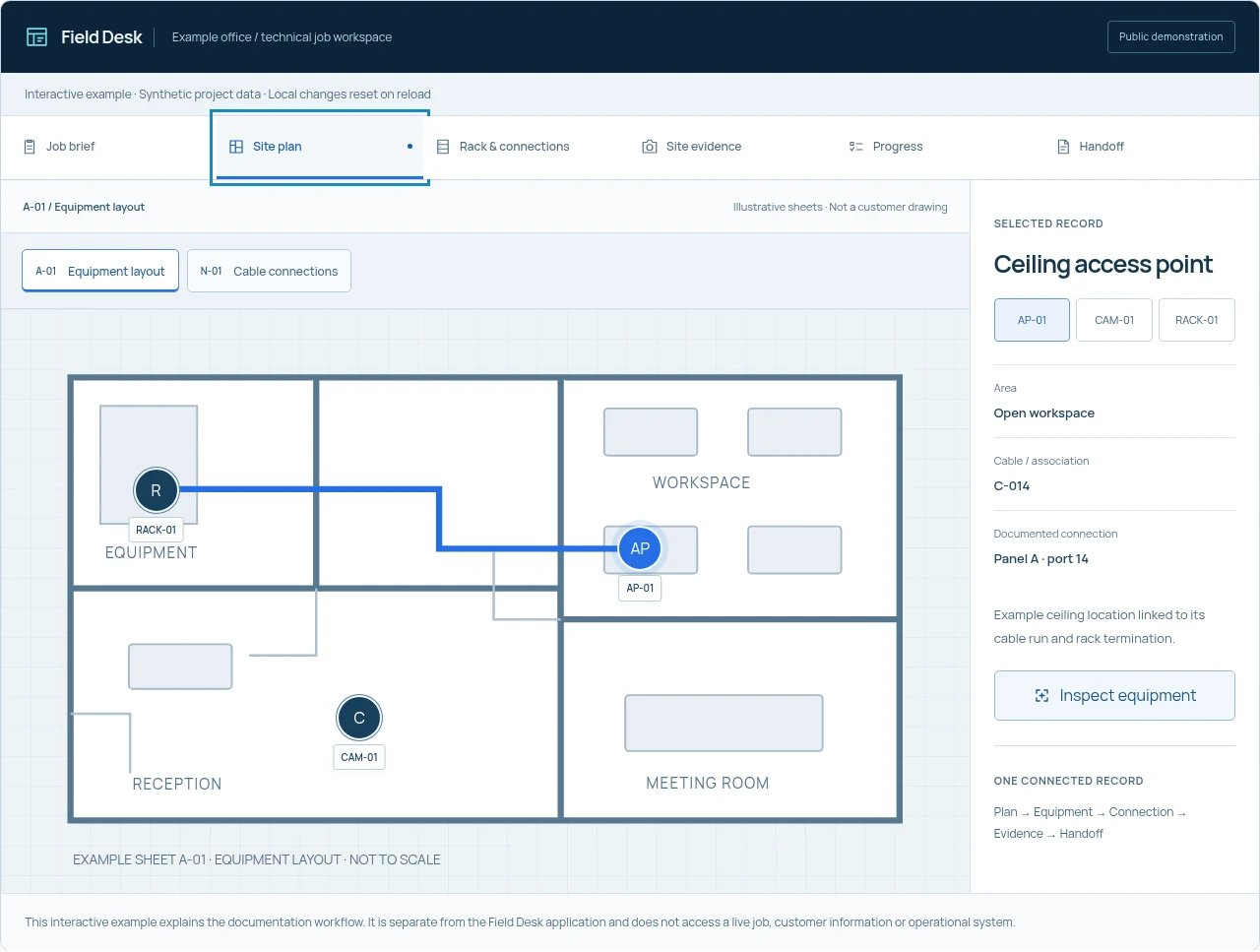
Follow an inspection observation into an example Field Desk record: retain the source, connect it to the plan and equipment, and let a person review it before handoff.
A synthetic observation with plan, equipment, reviewer and checklist context.
This is a browser-only workflow. No physical robot or private Field Desk application is connected.
05
Support diagnostics
A short site route and illustrative sampling points show how a future robot-carried instrument could keep authorized measurements associated with location and conditions.
Example sample locations and a proposed survey log with instrument provenance.
No radio measurements, network probes, coverage predictions or autonomous configuration.
Field Desk public demonstration · Synthetic example records
Field Desk / HQ × OPROV
Good evidence needs a useful place to go.
From job preparation to installation evidence, Optimal AI Systems is developing professional workflows that keep technical work organized and documented. Field Desk brings the drawing, device, cable and observation into one job context. HQ provides broader operational context. We developed these systems to support organized technical work.
A future OPROV connection would start with the same discipline: retain the source, associate the location, make uncertainty clear and require a technician’s review.
Physical job Begin with an agreed task and location.
OPROV assistance Explore supervised help at the work area.
Evidence capture Retain the image, source and conditions.
Field Desk record A technician reviews and associates the observation.
Professional report Explain the agreed work and open items.
The public demonstrations use synthetic records. OPROV does not currently send observations into the private platform.
Field 01 / Product direction
A place for the tools. A purpose for every mechanism.
The form expresses the research questions. Physical engineering must establish the answers.
Mobility & gear
A low cargo bay. A removable module.
The OPROV Modular Tool Dock is built into the rear chassis, with structural supports, alignment rails and positive retention latches. Preview a field-tool organizer or diagnostics module on the same proposed interface.
One arm explores cable and component presentation. The other carries inspection or lighting context. A divided front tray and side storage keep small field items close.
A camera-oriented mast, work lighting and a reserved diagnostics payload area connect the physical design to observation, authorized survey instruments and documentation.
Two modules. One proposed interface. The field-tool organizer holds illustrative connectors, keystone jacks, labels, fasteners and compact hand tools. The diagnostics preview represents unconnected survey and inspection equipment.
These are original generic modules. Fit with a specific commercial organizer, latch strength and allowable payload require measurement and physical validation. No manufacturer endorsement or verified compatibility is claimed.
OPROV Field 01 · Research collaboration
Build the future of field robotics with us.
We are looking for manufacturers, hardware teams and developers to explore how Field 01 could support real installation workflows—from a rack observation to supervised modular tool carrying. Start with one useful task, a controlled test and evidence we can review together.
Five proposed tracks · Hardware pilots and integration research to be scoped
From task to field record
Keep the task and its evidence connected.
01
Observe
Keep the source, task and test conditions with each observation.
02
Human review
Accept, correct or reject the proposed equipment or task association.
03
Document
Link reviewed information to a plan, rack item, cable run or work requirement.
04
Handoff
Prepare a clear record that keeps outstanding checks visible.
Can Field 01 help a technician build a more useful rack record?
Use an agreed sample rack, a prepared equipment schedule and fixed observation positions. Compare visible labels and equipment images with the reference, then let a technician accept, correct or reject each proposed observation.
Partner contribution
Camera and sensing manufacturers, mobile-platform developers, and teams able to provide capture interfaces, calibration guidance and a controlled test setup.
Optimal’s contribution
Installation task context: rack positions, equipment labels, documented ports and the information a technician needs at handoff.
Before testing
An authorized test area, a reference layout, explicit image permissions and a supervising operator. Agree on what is visible and what cannot be inferred from an image.
Evidence to retain
Source images and capture conditions; readable and missed labels; proposed equipment associations; reviewer corrections and unresolved observations.
Current limits
This is a proposed hardware experiment. The website does not inspect a live customer rack, diagnose faults or assess electrical safety.
How could a supervised survey keep each measurement connected to its location?
Define a short permitted route and sampling positions on a supplied plan. Explore how an approved instrument could contribute its own measurements, instrument identity and location notes to a technician-reviewed survey record.
Partner contribution
Survey-instrument manufacturers and robotics developers with documented data access, operating guidance and a suitable mobile platform.
Optimal’s contribution
Network-installation questions, site-plan context, proposed sampling procedures and the documentation needed to explain gaps and follow-up work.
Before testing
Written site and network authorization, agreed instrument methods, a clear movement area and rules for handling measurement data.
Evidence to retain
Instrument and method; sampling positions; uncertainty and repeatability; missing observations; operator interventions and reviewer decisions.
Current limits
The website performs no network probing or radio measurement. The concept’s sample points are illustrative, not a coverage map or a claim of measured signal quality.
Which small assistance task would genuinely help a technician at the workbench?
Start with an inert component or patch lead in a controlled fixture. Study presenting, holding and releasing it while the technician remains in control. Record unsuccessful attempts and interruptions before considering an installation task.
Partner contribution
Arm, gripper and mobile-manipulation teams that can provide verified component limits, interfaces and mechanical evaluation expertise.
Optimal’s contribution
Practical cable and component handling scenarios, technician feedback and a task record that distinguishes useful assistance from extra setup work.
Before testing
Mechanical and electrical review, checked stop behavior, defined force and speed boundaries, a controlled fixture and trained supervision.
Evidence to retain
Reach and clearance; grasp and release consistency; operator interruptions; failure cases; setup effort and usefulness to the technician.
Current limits
Field 01 is a concept. No lifting capacity, safe human collaboration, cable pulling, termination or autonomous installation has been validated.
04Proposed experimentEvidence & field documentation+
Could a robot observation become a reviewable job record rather than an isolated image?
Use a synthetic installation job to connect an example observation to a plan position, rack item or cable run. Keep the source image and proposed association together, let a technician review them, and show the accepted record alongside outstanding checks in a draft handoff.
Partner contribution
Robotics developers and integration teams with sample observation formats, event schemas and non-sensitive fixtures for testing review and correction behavior.
Optimal’s contribution
Field Desk’s job, plan, equipment, connection, evidence and closeout workflow, with practical requirements for technician review and documentation.
Before testing
Synthetic or explicitly approved data, agreed access boundaries, retained source context and human review before a proposed observation becomes an operational record.
Evidence to retain
Source attribution; proposed and accepted associations; reviewer edits or rejection; missing fields; correction history and outstanding items in the draft handoff.
Current limits
Field Desk is developed software; this public example uses synthetic data. OPROV is not connected to the application or a live customer job, and the robotics integration remains proposed.
05Proposed experimentModular storage & field assistance+
Could a retained, removable organizer keep lightweight tools close to a supervised technical task?
Evaluate the proposed common dock with a small-parts organizer and a diagnostics module. Begin with static fit, latch engagement, manual lifting access and center-of-gravity analysis before controlled low-speed moves. Record failed attempts and operator feedback.
Partner contribution
Mobile-base, embedded-system, retention-mechanism and manipulation developers who can support a bounded physical evaluation.
Optimal’s contribution
Networking and cabling workflows, realistic supplies, technician feedback and a structured Field Desk record for the test conditions.
Before testing
A measured module, engineering-reviewed supports and latches, validated stopping behavior, an agreed payload, clear test area, emergency stop and active operator supervision.
Evidence to retain
Module fit, retention engagement, load distribution, removal ergonomics, braking and stability, arm clearances and response to an interrupted move.
Current limits
The dock, modules and manual handling are website concept visualizations. No physical compatibility, certified load, autonomous operation or completed hardware test is claimed.
Tell us what your hardware or software can support, the documentation available, and the experiment you would like to shape together. Any pilot, integration access or partnership would be agreed separately.
Keep the useful task, the evidence and the remaining engineering questions together.
Explore six potential field applications
01
Intended application
Network installations
Tool carrying, cable assistance and equipment documentation around a technician’s installation workflow.
Tools · Cabling · Evidence
02
Intended application
Server rooms
Rack-face inspection, equipment observations and recorded site walkthroughs, with labels and port context retained for human review.
Racks · Equipment inventory · Labels
03
Intended application
Low-voltage cabling
Small-parts delivery, lightweight cable positioning and supervised assistance at wall data outlets and patch panels.
RJ45 connectors · Parts · Technician control
04
Intended application
Camera installations
Work-light positioning, inspection imagery and installation records while the technician performs the physical installation.
Lighting · Observation · Documentation
05
Proposed diagnostics module
Wi-Fi surveys
Future robot-carried survey hardware and authorized coverage documentation. A suitable radio, Ethernet interface, onboard computing and approved access would be required.
No live scans · Simulated route only
06
Intended application
Facility maintenance
Lightweight equipment transport and supervised infrastructure inspection, with observations connected to an agreed work order.
Mobile supplies · Inspection · Site context
Optimal Rover 01 / Engineering path
From workflow to tested hardware.
Software foundations and concept demonstrations inform the work ahead. Each physical capability needs evidence before it can become a product claim.
No completion dates, availability commitments or validated payload, compatibility or autonomy specifications are implied.
01Engineering roadmapSoftware foundations+
Begin with descriptions, simulation and supervised control before physical deployment.
Evaluate a stable platform and the controls needed for deliberate, bounded movement.
Chassis, motors, encoders and controlled stopping
Modular storage, retention testing and route constraints
Emergency-stop design and teleoperation
Power distribution, battery monitoring and cameras
03Planned researchPerception and inspection+
Connect observations to the environment and make their limits understandable.
Computer vision and LiDAR
Indoor localization and obstacle detection
Equipment inspection and networking payloads
Structured observations
04Future mechanical evaluationManipulation and field assistance+
Explore useful lightweight assistance through supervised testing of real mechanisms.
Arms, grippers and tool handling
Cable presentation
Safe force limits and operator supervision
Mechanical testing and real-world evaluation
05Proposed software integrationOptimal systems integration+
Investigate connecting authorized observations to practical field documentation.
Field Desk evidence and job progress
Mission logs and authorized diagnostics
Remote observation and reporting
Safe operator control
06Long-term explorationAdvanced robotics+
Use evidence from earlier research to assess more complex platforms and applications.
Humanoid platforms and dexterous manipulation
Human-robot collaboration
Mobile manipulation and potential commercial pilots
Residential use cases
The same platform / A longer-term extension
Beyond the job site.
The same removable dock could carry home-network adapters and small tools to a home-office work area. The scripted route, router observation and lightweight item presentation explore a longer-term residential use case.
The home scene extends the existing interior direction. The separate humanoid design explores standing-height reach and broader interaction. Both remain secondary to the commercial field-assistant focus.
Household autonomy, locomotion, safe physical collaboration and home-care services are not established capabilities.
Future updates will distinguish concept design, software simulation and physical hardware tests. Published demonstrations will be linked here as they become available.
Make the next experiment useful
Bring the hardware. Bring the hard questions.
Interested in field robotics, mobile manipulation, embedded systems, or commercial robotics testing? Optimal AI Systems welcomes inquiries about research collaboration, prototype evaluation, and pilot opportunities.
Optimal contributes real installation-workflow context and a platform for organizing the record. A worthwhile partnership starts with a bounded use case and evidence both sides can evaluate.
Modular tool storage and supervised mobile manipulation
Low-voltage and cable-assistance workflows
Infrastructure inspection and authorized diagnostics
Human-reviewed Field Desk integration
Controlled field tests and potential commercial pilots
Before a physical trial
Agree on site permission, operator supervision, emergency-stop behavior, mechanical and electrical review, force and speed limits, data handling and appropriate liability requirements.
This website controls no physical robot or customer infrastructure.
OPROV · Pronounced “OP-rove.” An early-stage robotics initiative by Optimal AI Systems, operated by Optimal Enterprises LLC. Northeast Ohio, United States.